How to turn research into a company's intellectual capital
A new generation research base where results and primary data continue to work, and AI helps to find new connections and deepen customer understanding.
Companies conduct dozens or even hundreds of studies, yet what they learn often remains scattered across reports, presentations, transcripts, and different suppliers’ systems. As the collection grows, it becomes harder to see everything the company already knows about its customers.
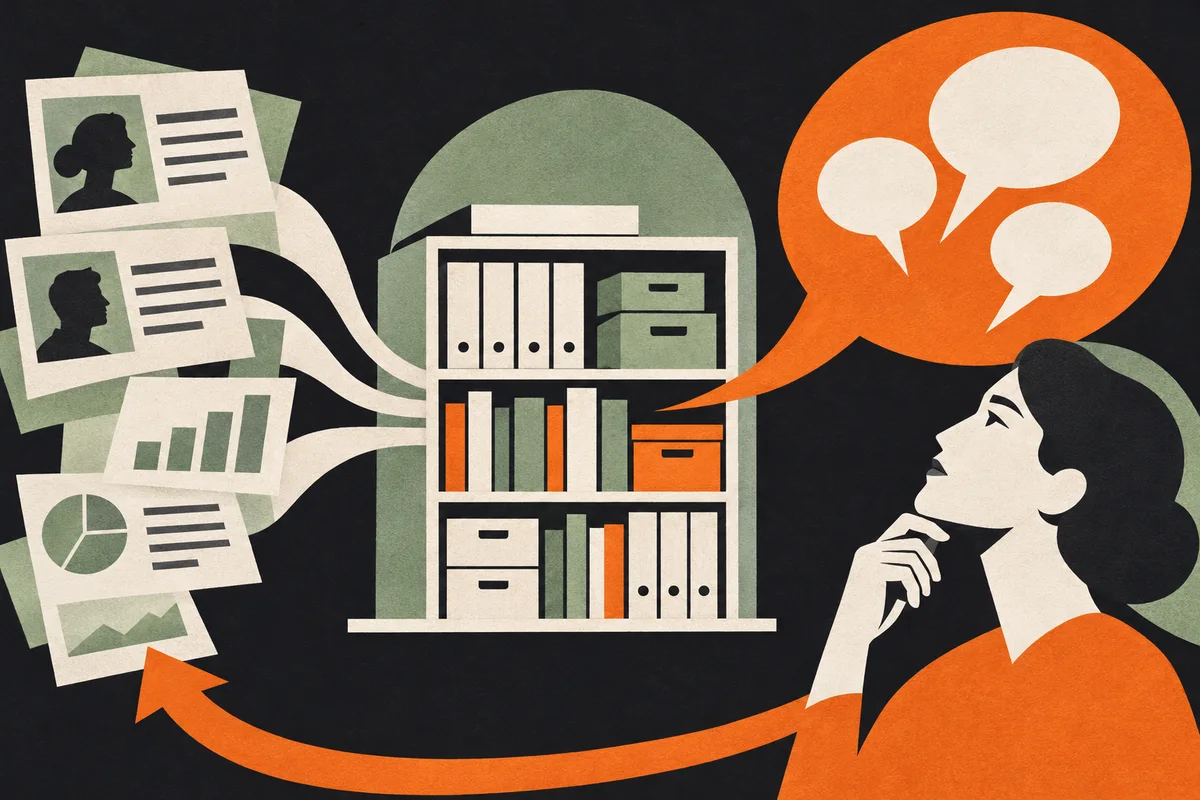
AI can bring studies together in one system where people can ask questions, compare projects, and find new connections. Such a knowledge base turns fragmented findings and raw data into intellectual capital that continues to work for the company.
The study ends, but its value remains
Most of the research answers a specific business question, but the final presentation contains only part of the collected knowledge. Beyond that, there are interviews, participant responses, observations, and context that can be useful when solving new tasks.
AI allows you to return to this data, compare studies from different periods and find new knowledge. But storage itself does not create value: research becomes intellectual capital when it regularly helps to make decisions and test hypotheses.
From document search to dialogue with knowledge
In a traditional database, the researcher has to search for documents, open them, and independently assemble the answer from individual fragments. In the new generation database, work begins not with a file search, but with a question.
The system analyzes the research and primary data, generates a response and shows the materials used. The question can be clarified by comparing segments and periods, and the researcher evaluates the quality of the data and interprets the result.
AI helps you see what gets lost between studies
Some patterns become noticeable only when comparing different projects, audiences, and periods. One motive may be repeated in several studies, a weak signal may be amplified, and new data may contradict previous conclusions.
AI is able to systematically compare thousands of responses, find recurring topics and changes that are difficult for a person to keep in the field of attention. It brings potentially important connections to the surface, and the researcher evaluates their significance and verifies the proposed hypotheses.
AI not only answers questions, but also offers new research ideas.
A system that sees the entire array of studies and regularly receives new data can act proactively. When it finds a recurring signal, contradiction, or change in the audience's behavior, she draws the researcher's attention to it.
AI can offer new research: formulate hypotheses, identify a target group, select a method, and prepare sample questions. Based on the insights found, it can also offer ideas for product, communication, and customer experience as starting points for discussion and validation.
Trust begins with the ability to verify every conclusion.
A convincing AI response is not enough. The researcher must understand which data the answer is based on and in what context they were obtained.
Therefore, the system should show the initial research, audience characteristics, the period of the study, and supporting fragments of primary materials. Trust arises not because AI is always right, but because the logic and grounds of each conclusion can be verified.
The accumulated knowledge becomes the memory of the company, not of individual employees.
Some of the research knowledge remains in people's memory: the context of the interview, the limitations of the data, and the reasons for the conclusions reached. Even saved materials may actually be lost if new employees are unaware of their existence.
A single database makes previously conducted research accessible and preserves its context. Employees, teams, and contractors change, but the accumulated customer understanding history remains within the company.
The next step is to link the research to other customer data.
Research helps to understand the motives and reasons for customer behavior, but it does not always show how people act in reality and what business results this leads to.
Support requests, reviews, product analytics, CRM data, and sales statistics complete this picture. Combining sources allows you to compare the words of customers with their behavior and understand not only the cause of the problem, but also its scale.
AI takes into account the context in which the company and its customers live
The attitude and behavior of customers are influenced by the economic situation, changes in legislation, actions of competitors, social trends and events within the company itself. Without this context, changes in research data can be difficult to explain.
AI can monitor relevant news and public data, compare them with research results, and warn against outdated conclusions. Possible connections are considered as hypotheses: the system identifies sources and suggests new research to verify them.
How we envision the research knowledge base at ReFocus
In our view, this is not a separate repository that exists apart from the current research work. The knowledge base and the existing research community should work in the same loop. Practically, this cycle has three parts.
1. All research and primary data are in a single database
All available company research is transferred to a single database: reports, presentations, interview transcripts, respondent responses, comments, photographs, audio and video recordings. The context of each project is preserved along with the materials — its goals, issues, methodology, audience, and period of implementation.
The company gets a common foundation of research knowledge instead of materials distributed among folders, corporate disks, and contractor systems. At the same time, not only ready-made conclusions are included in the database, but also primary data that can be accessed with a new question.
2. AI for working with accumulated knowledge
AI works with a single body of research and a relevant external context: it helps to conduct a dialogue with accumulated knowledge, compare projects and find possible patterns. The system not only answers questions, but also draws attention to new signals, offers research ideas, hypotheses, target audiences, and suitable methods for testing them. Each conclusion is related to specific studies, primary materials, or public sources, so the researcher can verify it and evaluate the context.
The purpose of the system is not to replace professional judgment, but to give the researcher the opportunity to work with the entire body of knowledge of the company at once, not limited to those documents about the existence of which he already knows.
3. The research community continuously supplements the database with new data
The main advantage of ReFocus is the opportunity to combine the accumulated base with the current work of the research community. In the same system, the company conducts discussions, diaries, surveys, and other research, receives new data from participants, and immediately puts it into a general context.
This creates a continuous cycle: the company asks a question to the accumulated database, discovers a gap or a new hypothesis, checks it on community members, and the answers received immediately complement the accumulated knowledge. Past research and ongoing conversations with customers no longer exist separately — together they form an ever-evolving system of customer understanding.
From individual studies to continuous understanding of clients
Research becomes intellectual capital when the accumulated knowledge is accessible, verifiable and constantly used in work. The new generation database helps to see the connections between projects, take into account the external context and offer ideas for new research.
In combination with the existing research community, a continuous cycle arises: accumulated knowledge generates hypotheses, they are tested on participants, and new data is returned to the general database. This is how we see the future of research at ReFocus — as an ever-evolving system for understanding clients.